
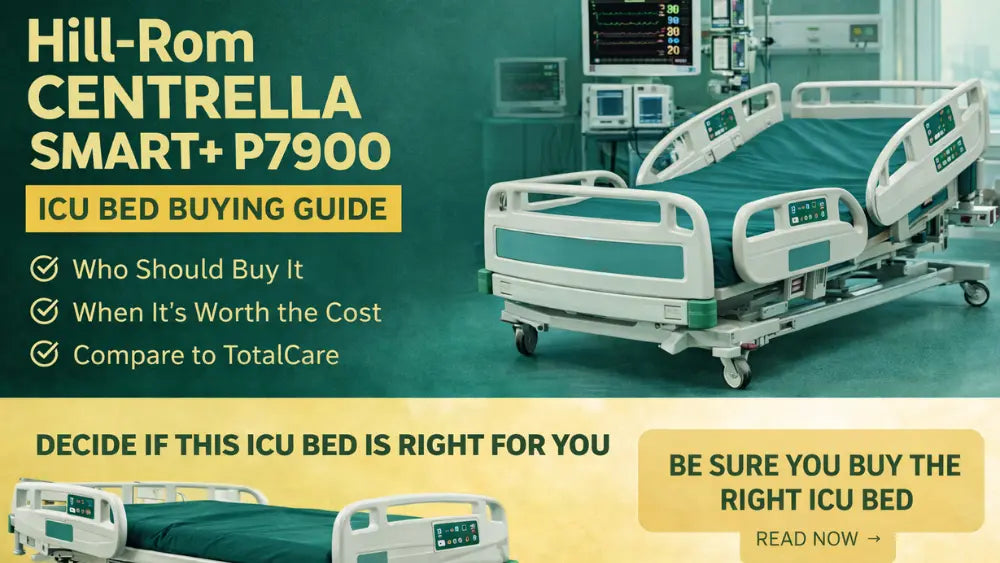
This is not a casual purchase.
Quick Answer: The Centrella hospital bed, formally the Hill-Rom Centrella Smart+ P7900 (from Hill-Rom, now part of Baxter), is worth it for high-acuity patients who need ICU-level support, advanced safety features, and stronger caregiver assistance. For standard home care, mobility support, or stable long-term use, it is usually more bed than you need and more money than you should spend.
The real question is not simply whether the Centrella hospital bed is good. It is. The better question is whether you are the right buyer for it or whether you are about to overspend on features you will rarely use.
This guide explains who should buy the Hill-Rom Centrella hospital bed, who should avoid it, what makes it different, how much it typically costs, and how it compares with other ICU hospital beds.
Featured Bed
The Centrella hospital bed was originally developed under Hill-Rom, now part of Baxter, and is widely recognized as a modern ICU platform for patient safety, mobility support, and caregiver workflow.
View the Hill-Rom Centrella Hospital Bed Smart+ P7900 ICU Bed
Why Buyers Consider the Centrella Hospital Bed Smart+ P7900
The Hill-Rom Centrella Hospital Bed Smart+ P7900 is designed for modern critical care environments. It is often considered by families managing complex home recovery, as well as facilities upgrading from older ICU bed platforms. Buyers are usually drawn to this model because it combines advanced patient safety features, mobility support, and caregiver-friendly controls in one bed.
What makes it attractive is not just that it is an ICU bed, but that it is built to reduce caregiver workload while supporting patients who need more than a basic full-electric hospital bed can provide.
1. Who This Bed Is Really For
Yes, Buy the Centrella Hospital Bed If:
- The patient is recovering from an ICU stay and still requires advanced positioning, monitoring support, or close caregiver management.
- Fall risk is a serious concern and bed exit alerts or smart safety features can help reduce incidents.
- You are managing a high-dependency patient at home with trained caregivers and clear clinical needs.
- Your facility is replacing older ICU beds and wants a more modern platform that improves workflow and usability.
- Caregiver efficiency matters because frequent repositioning, transfers, and mobility assistance are part of daily care.
Real-world example: A stroke patient discharged after a prolonged ICU stay may still require frequent repositioning, support with sit-to-stand movement, fall prevention, and a safer care setup at home or in a step-down setting. This is the type of scenario where the Centrella Hospital Bed Smart+ P7900 makes sense.
No, Do Not Buy the Centrella Hospital Bed If:
- You need basic elderly care or simple positioning support only.
- You are shopping for general mobility support rather than ICU-level functionality.
- No one involved in care is equipped to use or manage advanced ICU bed features.
- Your budget is under $3,000 and you need a practical solution, not a premium ICU platform.
- The patient is stable and a standard full-electric hospital bed would meet the need.
Blunt truth: If you do not already know why the Smart+ features matter for your situation, you probably do not need this bed.
2. What Makes the Centrella Hospital Bed Different
The Hill-Rom Centrella Hospital Bed Smart+ P7900 is more than a standard ICU hospital bed. It is designed as a patient safety and caregiver support platform. That matters because in real care environments, ease of use and clinical workflow often matter just as much as raw feature count.
- Bed exit alerts: Helps reduce fall risk by notifying caregivers when a patient attempts to leave the bed.
- Stand assist support: Helps with patient mobility and safer transitions during recovery.
- SlideGuard® technology: Helps reduce patient migration in bed and lowers repositioning effort.
- Caregiver touchscreen controls: Improves usability and speeds up common bed adjustments.
- Modern ICU platform: Better suited for high-acuity care than older refurbished ICU bed models with more limited interfaces.
Bottom line: The Centrella Hospital Bed Smart+ P7900 is often chosen because it reduces caregiver workload while offering smart safety features that older ICU beds may not deliver as effectively.
3. Price Reality: What You Can Expect to Pay
If you are evaluating whether the Hill-Rom Centrella Smart+ P7900 is worth it, price is a major part of the decision.
- Certified refurbished Centrella Smart+ P7900: Typically around $5,500 to $7,500, depending on condition, configuration, warranty, and market availability.
- New Centrella ICU bed: Often $12,000 or more, with pricing varying significantly by source and configuration.
Practical recommendation: For most buyers considering this model, a certified refurbished Centrella Hospital Bed Smart+ P7900 is the smarter purchase. It usually delivers the core value of the bed at a substantially lower cost than buying new.
View Centrella Smart+ P7900 Pricing and Product Details
Do You Need the Centrella MAX Mattress?
The bed itself is only part of the decision. Many buyers comparing the Centrella hospital bed are also trying to understand whether they need the Centrella MAX mattress or a different support surface.
In plain English: You only need the MAX mattress when the patient’s condition justifies a more advanced pressure redistribution and clinical support setup. If the patient is stable, more mobile, or using the bed for basic recovery or general home care, the MAX mattress may be more than you need.
Choose the Centrella MAX Mattress if:
- The patient has a high risk of pressure injuries or existing skin breakdown concerns.
- The patient is highly immobile and will spend extended periods in bed.
- Caregivers are managing a more complex ICU recovery situation.
- You need a more complete critical-care bed-and-surface system rather than just a bed frame.
You may not need the MAX mattress if:
- The patient mainly needs positioning, transfers, and general support.
- The care plan is short-term and not heavily pressure-management focused.
- The patient has some mobility and lower clinical complexity.
- Budget matters and a simpler mattress setup would still safely meet the need.
Buyer takeaway: Do not treat the mattress as an afterthought. For some patients, the support surface is a major part of the outcome. For others, adding the MAX mattress increases cost without adding meaningful benefit.
4. Our Experience With This Type of Buyer
At All Medical Beds, many buyers first ask about advanced ICU beds because they want the safest or most capable option available. In practice, however, a large percentage of families do not need a bed at this level. The best buyers for the Centrella hospital bed Smart+ P7900 are usually those managing ICU recovery, high fall risk, or clinically complex patients where the added features will actually be used.
That is why this bed can be either an excellent investment or an expensive mistake. The difference comes down to patient acuity, caregiver capability, and whether the clinical need truly justifies an ICU platform.
5. Centrella vs Alternatives: Where Buyers Often Get It Wrong
Most buyers do not make a bad decision because they choose a bad bed. They make a bad decision because they choose the wrong level of bed for the situation. The Hill-Rom Centrella Smart+ P7900 is strong, but it is not automatically the best fit for every ICU or high-acuity scenario.
Two common alternatives buyers compare it with are the Hill-Rom Progressa P7500 and the Hill-Rom TotalCare P1900.
Related options: Hill-Rom Progressa P7500 | Hill-Rom TotalCare P1900
Comparison Table
| Key Factor | Hill-Rom Centrella Smart+ P7900 | Hill-Rom Progressa P7500 | Hill-Rom TotalCare P1900 |
|---|---|---|---|
| Best Use Case | Modern ICU care, fall prevention, caregiver efficiency | Pulmonary therapy and more specialized ICU needs | Basic ICU care on an older platform |
| Technology Level | High | Very high and more specialized | Moderate to older-generation |
| Ease of Use | High | Moderate | Moderate to low |
| Home Suitability | Moderate for trained caregivers and complex cases | Low for most home care situations | Moderate in some cases, depending on need and support |
| Typical Refurbished Price | $5,500–$7,500 | $10,000–$13,000 | $4,000–$6,000 |
| Overall Value | Best balance of modern features and usability | Best for highly specialized ICU needs | Best for budget-conscious ICU buyers |
Important: If pressure management is one of the main reasons you are considering the Centrella hospital bed, evaluate the mattress and support surface along with the bed frame, not as a separate afterthought.
6. Which One Should You Choose?
Choose the Centrella Hospital Bed Smart+ P7900 If:
- You want a modern ICU hospital bed without moving all the way into more specialized and expensive territory.
- Fall prevention, smarter safety features, and caregiver efficiency are major priorities.
- The patient needs advanced support, but not necessarily the highest level of pulmonary therapy functions.
Choose the Hill-Rom Progressa P7500 If:
- The patient requires pulmonary therapy features such as rotation or more specialized ICU support.
- You are furnishing a facility-level critical care environment rather than a practical home recovery setup.
Choose the Hill-Tom TotalCare P1900 If:
- You need a more budget-conscious ICU bed.
- You are willing to accept older technology in exchange for lower cost.

Strong opinion: For many buyers, the Centrella Hospital Bed is the best overall balance of modern ICU features, usability, and value. The Progressa is often more bed than most buyers actually need. The TotalCare can still work, but it is older technology.
Hill-Rom Progressa P7500 | Hill-Rom TotalCare P1900
7. Home Use vs Facility Use
For Home Use
- Good fit for high-acuity recovery, ICU discharge, and patients with meaningful fall or mobility risk.
- Not a good fit for standard home care, stable long-term care, or general comfort needs.
- Important: Home use only makes sense when caregivers can manage the bed safely and the patient truly benefits from the added features.
For Facilities
- Strong upgrade path from older ICU bed platforms.
- Improves staff workflow and caregiver usability.
- Helps support patient safety in higher-acuity care environments.
Simple rule: For facilities, the Centrella often makes sense faster. For home care, it needs to be justified by real clinical complexity.
8. What Buyers Most Often Regret
- Buying the Centrella hospital bed when a basic full-electric hospital bed would have met the need.
- Ignoring space requirements for a large, heavy ICU bed.
- Underestimating delivery, setup, and caregiver training.
- Paying for advanced ICU features that never get used.
Hard truth: The Hill-Rom Centrella hospital bed solves clinical and caregiver-efficiency problems. It is not just a premium comfort upgrade.
9. Final Verdict: Is the Hill-Rom Centrella Smart+ P7900 Worth It?
Yes, it is worth it if you need ICU-level care, advanced safety features, smarter mobility support, and better caregiver efficiency.
No, it is not worth it if your needs are limited to comfort, simple repositioning, basic recovery, or routine long-term care.
Best buying strategy: Start with the patient’s clinical needs, then choose the simplest hospital bed that safely meets them. If those needs point to a modern ICU bed, the Centrella Smart+ P7900 is one of the strongest refurbished options available.
Explore More Options
Frequently Asked Questions
Who should buy the Hill-Rom Centrella Smart+ P7900 ICU bed?
The Centrella Smart+ P7900 is best for high-acuity patients, including ICU recovery cases, stroke recovery, fall-risk patients, and settings where advanced patient support and caregiver efficiency are important.
Is the Centrella Smart+ P7900 suitable for home use?
Yes, but only in medically complex home care situations. For standard home care, it is usually more expensive and more advanced than necessary.
How much does a refurbished Centrella Smart+ P7900 cost?
Certified refurbished Centrella Smart+ P7900 beds typically range from about $5,500 to $7,500, depending on condition, features, and availability.
Is a refurbished Centrella ICU bed a good option?
Yes. For most buyers considering this model, certified refurbished offers the best value because it provides the core functionality of the bed at a significantly lower cost than buying new.
What are the main advantages of the Centrella Smart+ P7900?
Its main advantages include bed exit alerts, modern caregiver controls, mobility support, reduced caregiver effort, and stronger safety and workflow features than many older ICU bed platforms.
When should I avoid buying the Centrella Smart+ P7900?
You should avoid it if the patient only needs basic positioning, mobility support, general elderly care, or stable long-term care where a simpler full-electric hospital bed would be more practical and affordable.
Is the Centrella better for facilities or home care?
It is generally a more natural fit for facilities and high-acuity care environments. It can work for home care too, but usually only when the clinical situation clearly justifies ICU-level support.
What is the biggest mistake buyers make with the Centrella Smart+ P7900?
The biggest mistake is overbuying. Many buyers assume a more advanced bed is automatically better, when in reality a simpler hospital bed may provide everything, the patient actually needs.
Does the Centrella Smart+ P7900 require caregiver training?
In most cases, yes. Because this is an advanced ICU hospital bed, buyers should expect a learning curve around controls, safety features, and practical day-to-day use.
Is the Centrella Smart+ P7900 better than the Progressa P7500?
It depends on the need. The Centrella is often the better overall fit for buyers who want modern ICU features, fall prevention, and usability. The Progressa is better suited to more specialized pulmonary therapy and higher-acuity ICU use cases.
Need Help Choosing?
If you tell us the patient condition, whether the bed is for home or facility use, and your budget range, we can help narrow the options quickly and recommend the right bed without pushing unnecessary upgrades.