
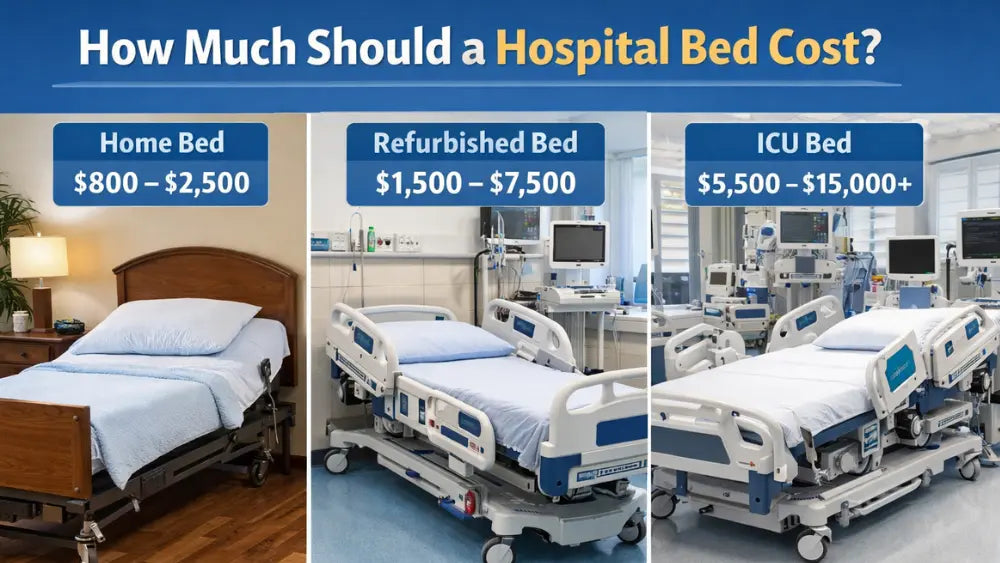
Quick Answer: A hospital bed should typically cost between $800 and $15,000+, depending on the type. Basic home hospital beds cost $800–$2,500, while refurbished hospital beds range from $1,500–$7,500. Advanced ICU hospital beds can exceed $10,000, especially with specialized features.
Most buyers overpay because they choose a bed that is more advanced than their actual needs. This guide explains what you should expect to pay, what affects pricing, and how to choose the right hospital bed without overspending.
If you're comparing general pricing with new hospital beds versus certified refurbished options, also see our refurbished hospital bed cost guide for a more detailed breakdown of value-oriented pricing.
Hospital Bed Cost by Type
Hospital bed pricing varies significantly depending on the level of care required. Below is a breakdown of the main types of hospital beds and what you should expect to pay for each.
1. Home Care Hospital Beds ($800 – $2,500)
Best for basic recovery, elderly care, and general home use.
- Simple electric positioning
- Easy to use and maintain
- Ideal for low-acuity patients
Browse home care hospital beds
2. Medical-Surgical (Med-Surg) Beds ($2,500 – $6,000)
Commonly used in hospitals for general patient care.
- More advanced positioning than home beds
- Improved durability and safety features
- Suitable for both facilities and some home care situations
3. Specialty & Long-Term Care Beds ($3,000 – $8,000)
Designed for extended use and specific patient conditions.
- Enhanced comfort and support
- Better pressure management options
- Used in nursing homes and long-term care settings
Browse specialty and long-term care hospital beds
4. Bariatric Hospital Beds ($6,000 – $20,000+)
Built for higher weight capacity and reinforced support.
- Wider frames and stronger construction
- Weight capacity up to 1,000 lbs.
- Designed for safety and stability
Browse bariatric hospital beds
5. Critical Care / ICU Beds ($5,500 – $15,000+)
Designed for high-acuity patients and advanced medical needs.
- Monitoring and therapy features
- Advanced positioning and mobility support
- Often unnecessary for standard home care
6. Birthing Beds ($3,000 – $10,000+)
Specialized beds used in labor and delivery environments.
- Designed for patient comfort and clinician access
- Supports multiple positioning configurations
- Primarily used in hospitals and maternity centers
What Should You Actually Pay? (Real Buyer Insight)
Here’s the reality most sellers won’t tell you:
- Most home buyers should spend $1,500–$4,000
- Most refurbished ICU buyers spend $5,000–$8,000
- Very few buyers actually need $10,000+ ICU beds
Key takeaway: The right bed is the simplest one that safely meets the patient’s needs.
Not sure what price range is right for your situation? Most buyers are deciding between 2–3 bed types and do not need the most expensive option.
Why Hospital Bed Prices Vary So Much
- Bed type: ICU beds cost more than home beds
- Brand: Premium brands like Hill-Rom and Stryker command higher prices
- Features: Monitoring, mobility assist, and automation increase cost
- Condition: New vs refurbished vs used
- Mattress system: Can add $1,000–$5,000+
- Delivery: White-glove service can cost $500–$2,000+
Before you spend more: Check the warranty that comes with the bed and whether you need ICU-level features, a specialty mattress, or white-glove setup. Those are the biggest drivers of cost, and the most common sources of overbuying.
Biggest Mistake Buyers Make
Most buyers assume that a more expensive hospital bed is better.
That’s wrong.
- They buy ICU beds when a home bed would work
- They pay for features they never use
- They overlook mattress and setup costs
Reality: Overbuying is the most common and most expensive mistake.
Many buyers who think they need an expensive ICU bed are often better served by hospital beds for home use or by exploring refurbished hospital bed pricing first.
Best Buying Strategy
- Start with the patient condition
- Choose the lowest complexity bed that meets the need
- Consider refurbished for best value
Still unsure? Most buyers are comparing 2–3 options.
Talk to our team and get a clear recommendation
Final Recommendation
If you’re unsure, start simple. Only move to advanced ICU beds if the patient’s condition truly requires it.
Need help narrowing it down? Tell us whether the bed is for home or facility use, the patient condition, and your approximate budget. We’ll point you to the best-fit option without pushing unnecessary upgrades.
Book a free 30-minute consultation | Shop certified refurbished beds | Browse home hospital beds
Frequently Asked Questions
How much should a hospital bed cost for home use?
Most hospital beds for home use cost between $800 and $2,500, depending on whether the bed is manual, semi-electric, or full-electric, and whether a mattress and rails are included.
How much does a refurbished hospital bed cost?
Certified refurbished hospital beds typically cost between $1,500 and $7,500, depending on the brand, condition, features, and whether the bed is designed for home care, med-surg use, or ICU-level care.
Why are ICU hospital beds more expensive?
ICU hospital beds cost more because they include advanced features such as therapy modes, improved patient positioning, caregiver controls, alarms, mobility assistance, and higher-acuity support systems.
Are refurbished hospital beds worth it?
Yes, for many buyers they are. A certified refurbished hospital bed can offer hospital-grade quality and major savings compared with new equipment, especially for home care and budget-conscious facilities.
What is the biggest mistake buyers make when shopping for a hospital bed?
The most common mistake is overbuying—choosing a more advanced and expensive bed than the patient actually needs. In many cases, a simpler bed is safer, easier to use, and far more cost-effective.
Does a hospital bed mattress affect total cost?
Yes. Mattress choice can significantly affect total cost. Basic foam mattresses cost less, while pressure redistribution, low-air-loss, and specialty mattresses can add substantially to the final price.
Should I buy new or refurbished?
If budget, value, and practical performance matter, refurbished is often the smarter choice. New beds may make sense for certain facilities or buyers who need the latest platform, but many families and smaller care settings do well with certified refurbished options.
Can Medicare or insurance help cover hospital bed costs?
Sometimes, but coverage depends on the patient’s situation, medical necessity, and how the bed is being obtained. Many buyers choose to purchase directly to avoid restrictions, delays, or limited options.